
How should we live?
Apology and plan..and request for feedback

Just a quick note to apologize for my slow down in output. I’m still going for 4 posts a month. However, the next two months might be a little slow — some domestic issues, and a short work trip to Europe.
However, I am working on a detailed manifesto and programme for a post-liberal, distributist political economy which I hope will be ready to fly within 10 days. Watch this space.
And finally, I’m experimenting with software to create an audio and video podcast, with an avatar reading some of my essays — accessible through Substack but also Spotify, Youtube and Apple Podcasts. However, I’m nervous about this. I’m very suspicious of AI and the transhumanist agenda more generally. I think it’s pretty evil and possibly an existential threat to civilization — if not humanity. On the other hand, I’m being forced to use it at work. The university is reorganizing its whole modus operandi around Gen AI. The technology is running rife through the entire economy….and to be honest, if we are using the Internet at all — computers, networks software, Apps — then we are already completely integrated into what
calls The Machine. Unless we are willing and able to jump off the train completely, I’m not sure it makes much difference. I would honestly happily make that move — but I can’t afford to retire, and I have 4 kids to launch all of whom depend on jobs and connectivity in this complex technological civilization that we have built. Given this reality, taking myself off-grid would feel fake and disingenuous. I suppose this is the dilemma faced by slowly simmering frogs everywhere.The premise of the manifesto is that we are caught between the horns of a dilemma. An accelerating technological trajectory of transhumanism associated with the globalist liberal agenda. This version of ecological modernism assumes that all biophysical limits to growth can be overcome with technology. Ironically, although Greens everywhere seem to be on board, this is the technological modernism of liberal economist Julian Simon in the 1970s. But even if Simon was right and we can overcome environmental constraints, it is an unholy, inhuman project that will see humanity subordinated to the surveillance state and increasingly destroyed — quite literally — as the metaphysic of transhumanism plays out.
The alternative to this trajectory — some kind of voluntary degrowth — has always been to reject modernity and wear a hair shirt — uncomfortable, unpopular and a political non-starter. No civilization in history has ever voluntarily relinquished power over nature or people. For all the books written on ‘voluntary simplicity’ and the like, it has always been a total fantasy. Gandhi was beloved — but Indians wanted technology, national sovereignty, military power and a space race. They went with Nehru.
The choice has always been the same — an either /or — probably for the whole history of humanity. Hunter gatherers who rejected farming were displaced by the unhealthy, ecologically destructive innovators who simply had more kids. The history of the last 10,000 years is really summed up in that insight. Farmers with more kids, pushing ecologically more benign and happier hunter-gathers to ever more marginal land and now into extinction.
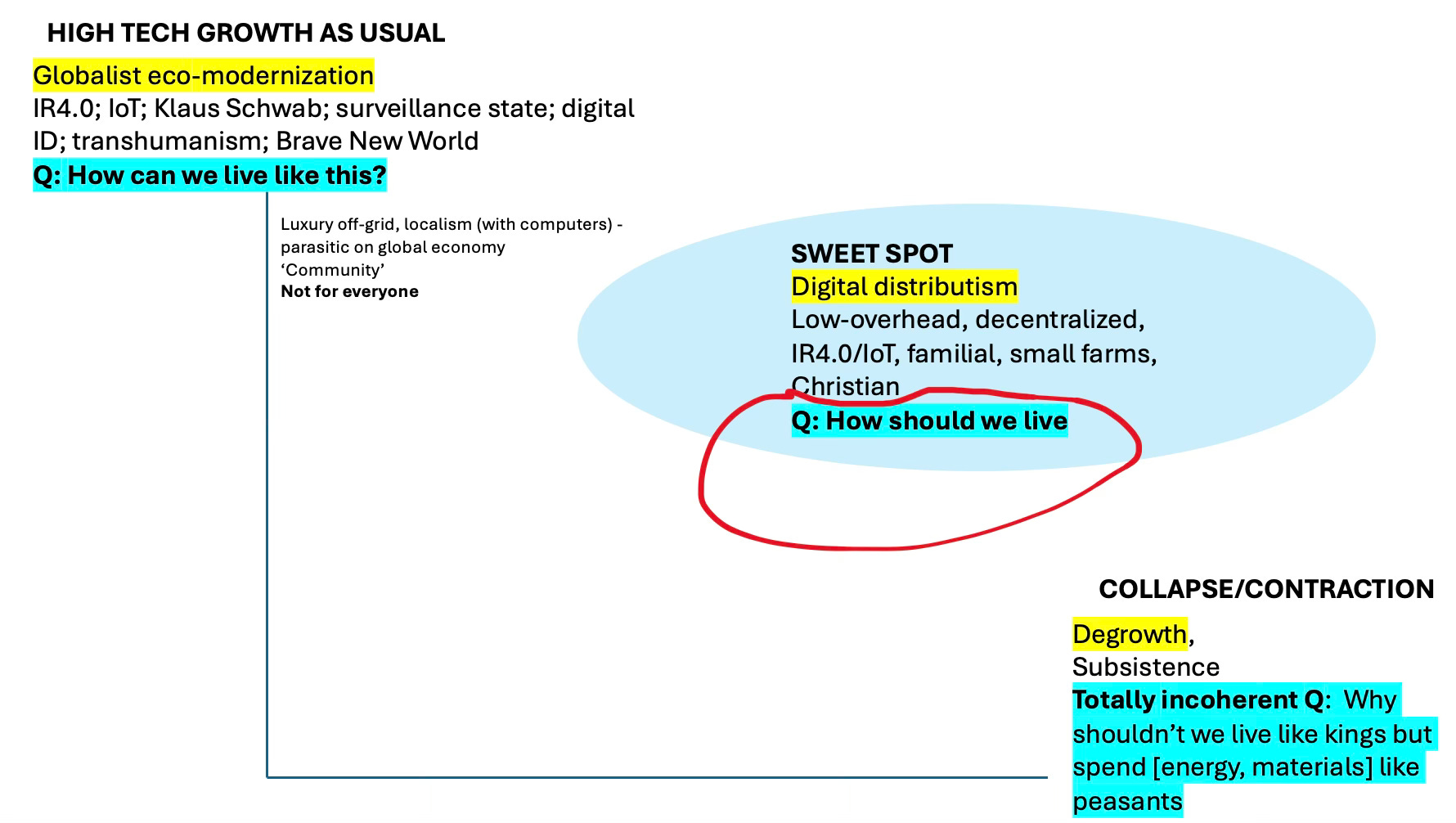
From this point of view the omens are not great. On the other hand, as Lewis Mumford and Patrick Geddes observed, we always have technological choices. The manifesto I’m advancing will try to delineate the sweet spot of digital distributism — a trajectory that doesn’t require us to jump off the train, but rather slow it down, re-frame it with a medieval, Christian and Aristotelian metaphysics (virtue ethics), radically increase the numbers of decision-makers and innovators in play and direct it toward towards a different question. Not ‘How should we live like this?’ but rather, ‘How should we live?’
I look forward to sharing it with you soon
Please let me know your thoughts — especially on the kind of things you’d like to read, the topics that most interest you and books that you would like reviewed,
Looking forward to seeing your ideas. I'm "lucky" to work on a hands-on local government job that won't be affected by AI, though it's front and center in any cultural unrest.
On the broader subject: I recently became a father and am very mindful of how complex it will be to raise my child and any others in the changing world. On a very small scale, we homestead, which I hope will provide grounding. We also recently left our Baptist Church for Orthodoxy, and it's nature as grounded and stable will also be good I think.
I agree that AI can be a threat to the humanity inherent in most human endeavor. But I see a choice between reckless exploitation of any technology and thoughtful use to enhance human abilities. We've seen this throughout history. Even non-inventions such as rocks can be weapons or building blocks or domestic tools. Using AI to replace rather than supplement human effort degrades output and produces "workslop".
Using tools as an analogy, I'm well aware that power tools enable my 80-year old body to accomplish tasks that would take multiple younger men using only hand tools. However, used carelessly, those tools can also turn good material into risky or useless junk.